
Marble Mountains from Hoi An: A Day Trip Guide (2026)
The Marble Mountains are five limestone and marble outcrops on the coast between Hoi An and Da Nang, riddled with caves, Buddhist temples, and a summit view that takes in both cities and the sea. They have been a pilgrimage site for over a thousand years and one of the most-visited day trips in central Vietnam for the last two decades.
From Hoi An the realistic commitment is half a day. Door to door, plan on 30 minutes each way and two to three hours on site, more if you want every cave. The whole thing fits inside a morning if you start at opening - which is what I would do, with one caveat about timing the light that most guides skip (more on that below).
The usual question is Marble Mountains versus Ba Na Hills versus My Son. They serve different purposes. Marble Mountains is the closest, the cheapest, and the one where the history lands hardest - the Vietnam War field-hospital cave is affecting in a way most tourist sites are not.
Getting there from Hoi An
The Marble Mountains sit about 19-20 km north of Hoi An, in Da Nang's Ngu Hanh Son district (and only 8-9 km south of central Da Nang, if you are coming the other way). Four ways to get there, in the order I would rank them.
Grab car or taxi. A one-way Grab from Hoi An runs around 250,000-280,000 VND and takes 30-35 minutes. The catch: you cannot reliably get a Grab back, since drivers do not hang around the area. Either pre-book a return pickup, pay your driver to wait (around 100,000 VND per hour), or plan on flagging a metered taxi at the entrance.
Private car with driver. The cleanest option for a half-day. Around 400,000-500,000 VND round trip with the driver waiting through your visit. Worth it for two or three people, and most Hoi An hotels can arrange it in half an hour.
Motorbike or scooter. Roughly 30 km along Vo Nguyen Giap, Da Nang's coast road and one of the better rides in central Vietnam. About 45 minutes each way. A scooter rents for 120,000-150,000 VND per day in Hoi An. Only attempt this if you are already comfortable on Vietnamese roads - the road is easy, the city traffic on either end is not.
Group tour bus. Most Hoi An operators bundle Marble Mountains with Lady Buddha and Son Tra, or with My Son. Hotel pickup, English guide, sometimes lunch. Cheapest per person, slowest overall, since you are back on the bus on someone else's clock.
Tickets, entry, and the elevator question
The standard adult ticket is 40,000 VND, covering entry to Thuy Son, the only one of the five mountains open to visitors. The Am Phu (Hell) cave is a separate 20,000 VND ticket bought on site - pay it. Skip Am Phu and you have cut one of the two most distinctive caves on the property.
Children under 6 are free. From age 6 up, everyone pays the full adult rate; there is no half-price tier for older kids, whatever you may have read. Payment is cash, in VND.
There are two entrances, and only one of them has the elevator. Gate 1, on the western side, is the classic stone-staircase route - about 156 steps up to Tam Thai Pagoda. Gate 2, on the eastern side by Linh Ung Pagoda, is where the glass elevator is. Both sit on the same road (Huyen Tran Cong Chua), a few hundred meters apart, but if your taxi drops you at the staircase gate and your knees were counting on the lift, you are out of luck.
The elevator costs 15,000 VND one-way or 30,000 VND return, on top of entry. It effectively runs as an up-only convenience for most people: ride it up from Gate 2 to skip the climb in the heat, then wander down the stairs at your own pace. My take - enter at Gate 2, elevator up, walk down. Tell your driver "cong so 2" (gate 2) so you land at the right one.
Time the light, not just the crowds
Most guides tell you to arrive at opening (the site runs roughly 7 a.m. to 5:30 p.m., though hours drift seasonally, so confirm on the day). That advice is right for two reasons: cooler climbing weather, and empty caves before the tour buses roll in around 10 a.m.
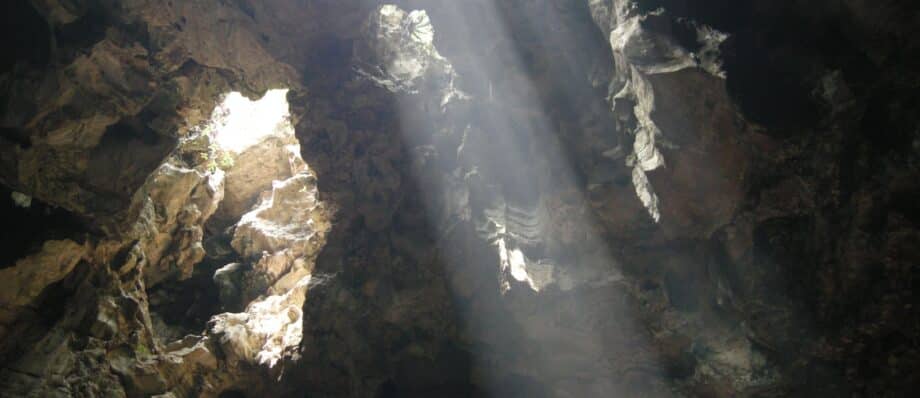
But there is a trade-off. The signature photo of the Marble Mountains - the shafts of light dropping through holes in the ceiling of Huyen Khong cave onto the Buddha statues below - only happens when the sun is high enough to angle through those openings. That is roughly noon to 2 p.m. on a clear day. Arrive at 7 a.m. and you get the cave to yourself but flat, sourceless light. Arrive at midday and you fight the crowds but catch the beams.
The fix, if the light show matters to you: start early at the other caves and pagodas, then circle back to Huyen Khong near midday. If you only care about beating the heat, go early and do not worry about it.
The five mountains, briefly
Marble Mountains is shorthand. There are five outcrops, each named for a classical element, and visitors only enter one - but the names turn up on signs and in guide patter often enough to be worth knowing.
Thuy Son (Water Mountain) is the only one open to the public, the largest, and the most temple-rich. Every cave on the must-see list is here. When someone says "we did Marble Mountains," they mean Thuy Son.
Moc Son (Wood Mountain) is the smallest, southeast of Thuy Son. Closed.
Hoa Son (Fire Mountain) is two adjacent peaks. Closed, though a Champa-era altar is visible on the slope from the road.
Kim Son (Metal Mountain) sits west of Thuy Son. Closed, but you can spot the Quan Am Pagoda built into its base.
Tho Son (Earth Mountain) is the longest, running parallel to the coast. Closed.
The closures are partly conservation and partly because the lower mountains are honeycombed with quarry tunnels from the marble industry that ran here until the 1990s, when quarrying was banned to protect what was left. You can still buy carved marble from the workshops at the base, but the stone is now shipped in from other provinces and carved on site - the local mountains are off limits.
The caves at Thuy Son
You can clear the headline caves in 90 minutes if you keep moving; two and a half hours is more comfortable.
Huyen Khong cave is the largest and the one everyone photographs. Buddhist statues sit in alcoves cut into the limestone, and light beams down through natural openings in the roof onto the central altar. It also served as a Viet Cong field hospital during the Vietnam War: after fighters drove US forces off the mountains in 1968, medics treated wounded soldiers here, in caves that looked directly down on the American base at China Beach. A plaque inside honors a People's Liberation Armed Forces unit, including its female artillery members. (For the wider history: a celebrated 1965 sapper raid on the nearby Marble Mountain Air Facility destroyed 19 US aircraft - a separate event from the cave hospital, though guides sometimes blur the two.) Worth slowing down for either way.
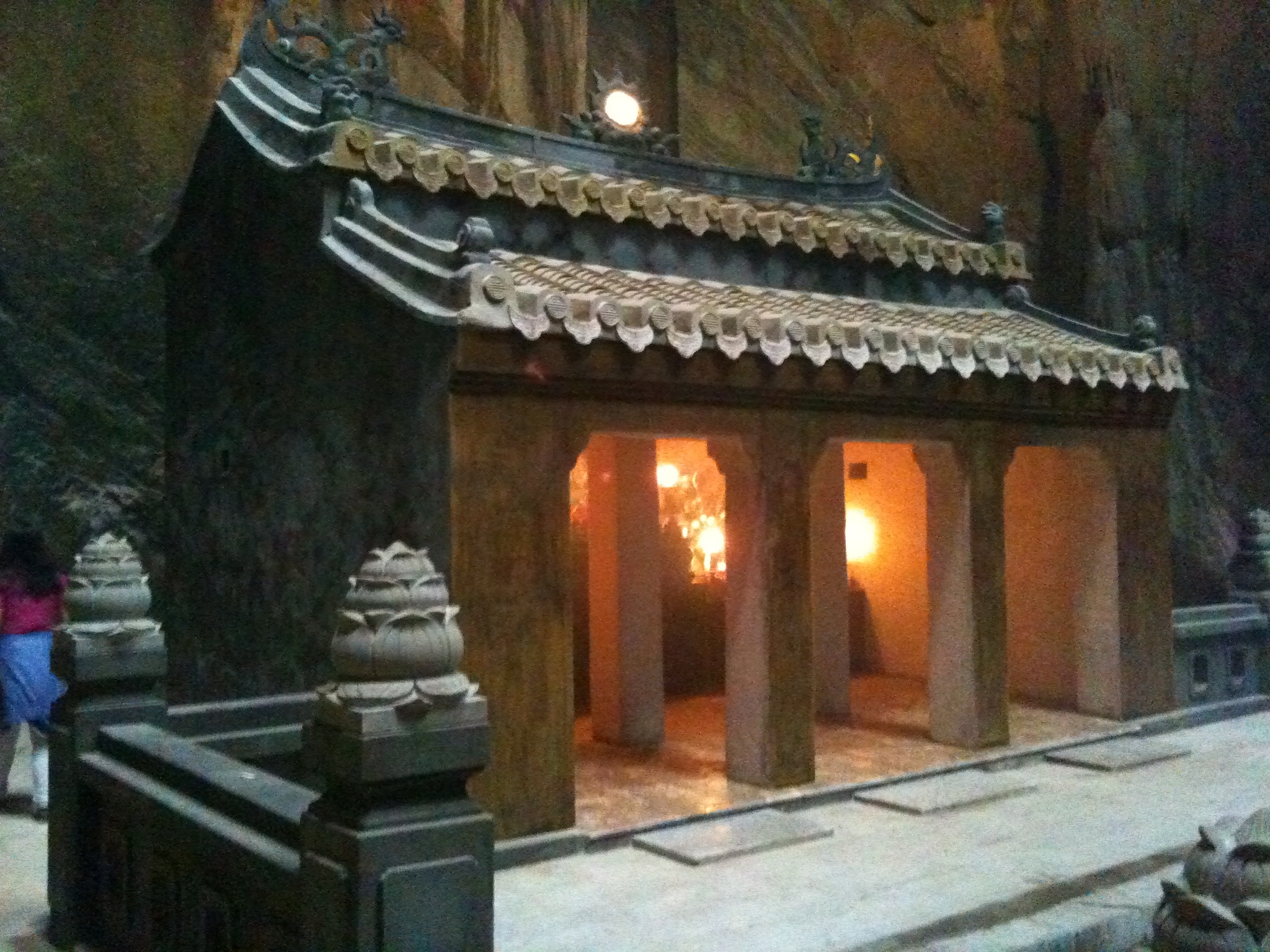
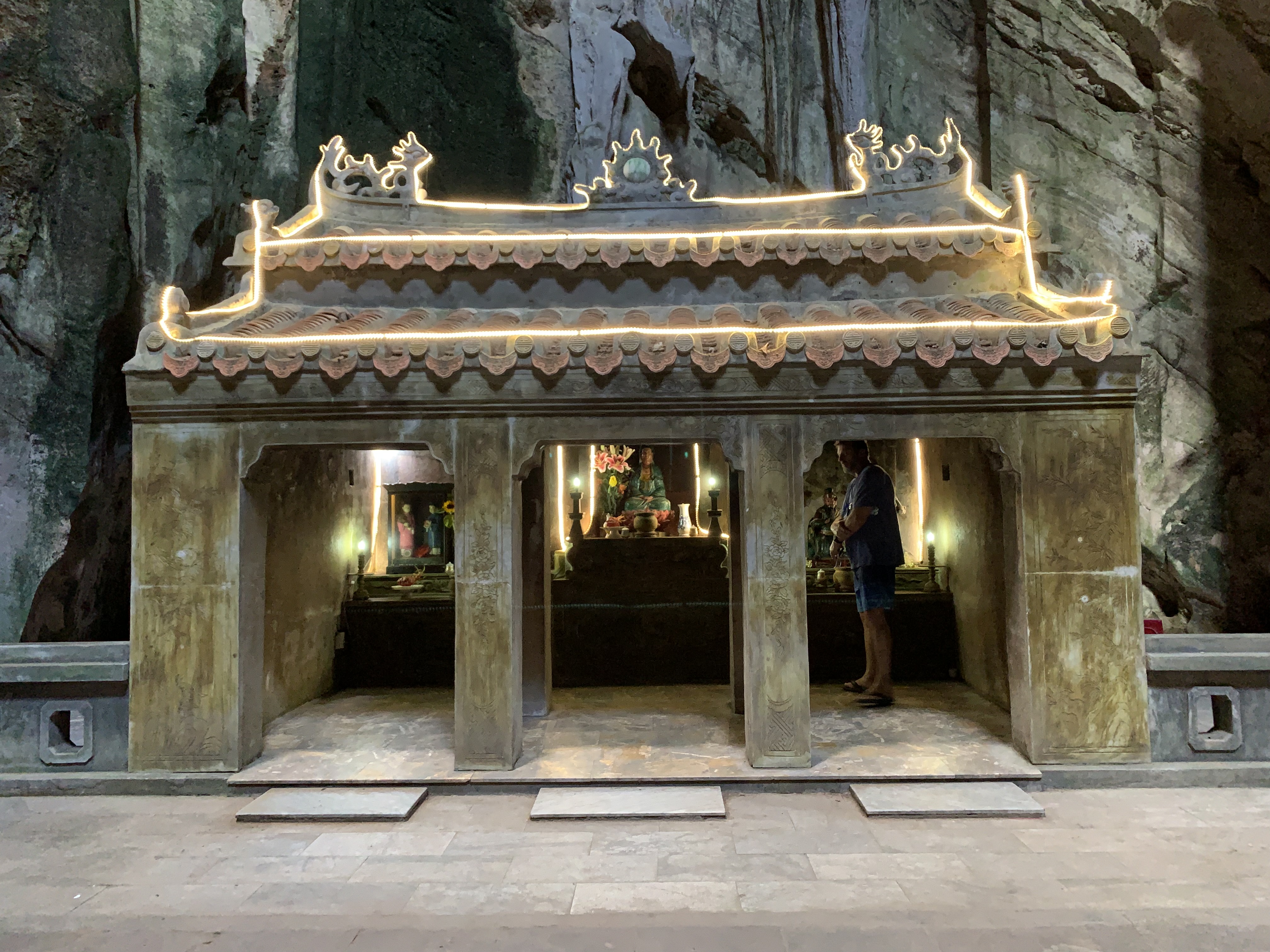
Tang Chon cave is smaller and quieter, with shrines tucked into side chambers and some of the older carved Buddhas on the mountain. Five minutes is plenty if you are moving.
Am Phu cave (Hell cave). Separate ticket, separate entrance near the base. The descent runs through a stylized Buddhist hell - graphic stone reliefs of the punishments waiting for sinners, lit red in the lower chamber - with a parallel ascending path for heaven. Camp, theatrical, and the most memorable cave on the property. Do not skip it because the ticket is separate.
Van Thong cave has a narrow vertical scramble to a peephole at the summit with panoramic views of Da Nang and the coast. Skip it if your knees or the heat are against you; otherwise it is the best free view on the mountain.
Linh Ung and Xa Loi Pagodas sit on the upper levels and are working temples, not caves - worth the climb for the architecture and the sea-side viewpoint behind Linh Ung.
What to wear and how fit you need to be
Plan on a few hundred stairs, multiple cave entries with ducking and uneven stone, and at least an hour in direct sun if you skip the elevator. None of it is technical, but it adds up.
Real shoes, not flip-flops - the cave floors are slick limestone, worse after rain, and the steps inside Huyen Khong are worn smooth from a thousand years of pilgrim feet. Light, breathable layers, since the caves run 5-7 degrees cooler than outside and the temples up top usually ask you to remove your shoes (socks help). A hat, sunscreen, and at least a 750 ml water bottle per person - the vendors at the top mark up by three or four times.
If 150 steps in the heat is a problem, take the elevator both ways from Gate 2. No shame in it.
Make it a full day
Marble Mountains alone is a half-day. The standard ways to round it out from Hoi An:
Plus Lady Buddha and Son Tra peninsula. The most popular pairing. Lady Buddha is the 67-meter white statue 15 minutes north, at the foot of the green Son Tra peninsula. Add Son Tra's coastline and viewpoints and you have a 6-7 hour day with three distinct stops.
Plus My Son sanctuary. Doable as a long day but they are in opposite directions from Hoi An, so it means a sunrise start. Better as separate days if you have them - see the My Son day-trip guide.
Plus Ba Na Hills. Possible but punishing - Ba Na alone is a full day, so pairing both makes a 12-hour grind. Skip unless you have to compress two trips into one. The Ba Na Hills guide has the details.
For most visitors the Lady Buddha combo is the right call: one driver, one morning, three of central Vietnam's coastal sights crossed off. If you would rather book it than negotiate a driver, this is a solid prepaid version with Hoi An pickup.
Where to eat nearby
The strip of seafood restaurants on Non Nuoc Beach sits about 200 meters east of the entrance - casual lunch spots with plastic chairs on the sand, fresh seafood by the kilo, and prices roughly 30% under Hoi An. Pick the one with the most local motorbikes parked outside; that heuristic works across most of Vietnam.
If you would rather eat back in town, time the return for golden hour in the Old Town and stop at Banh Mi Phuong at 2B Phan Chu Trinh (the Bourdain shop) on the way through. It is the only branch worth the queue, despite what a few outdated guides claim.
For more day trips out of Hoi An, see all Hoi An day-trip guides.
Frequently asked questions
How much does it cost to visit the Marble Mountains?
40,000 VND for adult entry to Thuy Son, plus 20,000 VND for the separate Am Phu (Hell) cave, plus 15,000 VND one-way (or 30,000 return) for the elevator if you want it. Children under 6 are free; from age 6, everyone pays full price. Cash only.
Where is the elevator at the Marble Mountains?
At Gate 2, the eastern entrance by Linh Ung Pagoda. Gate 1 on the western side is the stone-staircase route with no lift. Both gates are on Huyen Tran Cong Chua street. If you want the elevator, tell your driver "gate 2" (cong so 2).
How long do you need at the Marble Mountains?
Two to three hours covers Thuy Son's headline caves and pagodas comfortably. With travel from Hoi An (about 30 minutes each way), it is a half-day trip. Pair it with Lady Buddha and Son Tra to make a full day.
What is the best time to visit?
Early morning, around opening at 7 a.m., for cool air and empty caves before the tour buses arrive. The exception: the famous light beams in Huyen Khong cave only appear around midday on a clear day, so circle back there near noon if that photo is the point.
Is the climb hard?
It is a few hundred uneven stone steps with some ducking in the caves - not technical, but a workout in the heat. If stairs are a problem, take the elevator both ways from Gate 2. Wear real shoes; the limestone gets slick.
Related Hoi An guides
- Hai Van Pass - the Hoi An to Hue motorbike route
- Things to Do in Hoi An - what is actually worth your time